
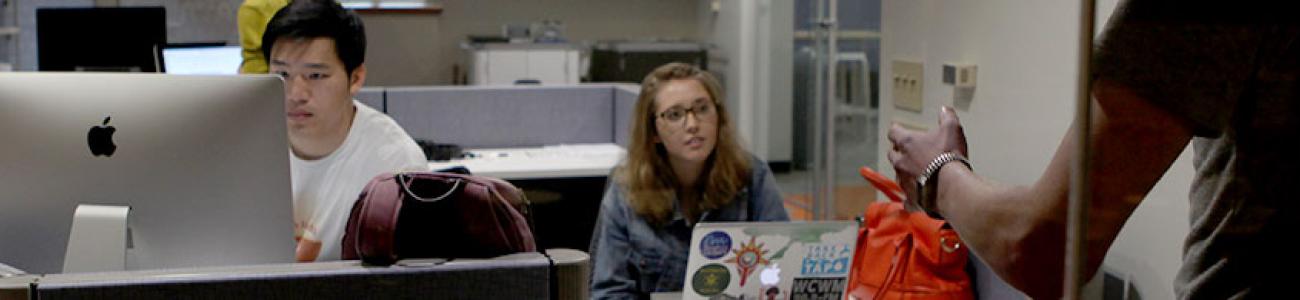

The Media Center is named after Charlie Reeder who founded the Audiovisual Department at Swem Library and served as director of audiovisual services from 1965 until 1978. Coming to William & Mary after a 32-year career in the U.S. Navy, Reeder realized decades ago that technology would drive the university library of the future. Reeder’s daughter, Sharon Reeder McCarthy ’69, has established an endowment that will support the ongoing operations of the Media Center.
The W&M Libraries’ Charles W. Reeder Media Center partners with the teaching and learning community to explore 21st Century learning, research, and curricular goals of William & Mary and W&M Libraries by providing the space, technology, resources, services and expertise to support creative and generative uses of multimedia technology.
We are committed to lifelong learning at W&M Libraries, and have a mission of fostering an environment where everyone is included, engaged, supported, and encouraged to tap into their creativity.
How We Support Media Projects
The Reeder Media Center’s approach to media support grows out of the broader mission of W&M Libraries : expanding access, supporting teaching and research, encouraging lifelong learning, and helping people develop the skills they need to pursue their own intellectual and creative work.
We provide shared access to media equipment, production spaces, instruction, and consultation for students, faculty, and staff. While our goal is to provide access to useful tools, our primary goal is to help people learn how to use them effectively and develop sustainable approaches to their own media projects.
Many of our spaces and tools are capable of producing professional-quality results, but the Media Center is an educational service rather than a professional production service. Our staff can help with planning, training, troubleshooting, and developing workflows, but we generally do not serve as producers, recording engineers, editors, or production crews for ongoing projects.
Our equipment collection is likewise a shared academic resource rather than a large-scale production depot. Cameras, microphones, laptops, lighting, and other equipment must remain available to support a broad community of users and a wide range of coursework, research, and individual learning. Requests involving unusually large quantities of equipment, extended exclusive use, or resources that would substantially reduce availability for others may not be supportable.
For larger or recurring projects, we encourage people to contact us early. We are happy to help determine what the Media Center can reasonably support, identify appropriate equipment and spaces, and discuss when a project may require dedicated production resources beyond what a shared academic library media center can provide.