Being a student again at the Digital Humanities Summer Institute
Being a student again at the Digital Humanities Summer Institute
The Digital Humanities Summer Institute (DHSI) is an annual digital scholarship training institute that is organized by the Centre de recherche interuniversitaire sur les humanités numériques (CRIHN) and takes place at the Université de Montréal campus.
Every summer, DHSI brings together faculty, staff, and students from the arts, humanities, library, and archives communities as well as independent scholars and participants from areas beyond. DHSI provides a community-based environment for discussing and learning about new technologies and how they influence teaching, research, creation, and preservation in different disciplines. Participants share ideas and methods as well as develop expertise in advanced technologies during this time of intensive coursework, seminars, and lectures.
William & Mary Libraries provides funding for a group of faculty and graduate students to attend DHSI. Assistant Professor of Art History and American Studies Alyssa Quintanilla attended DHSI for the first time after finishing her first year at William & Mary. A year of firsts! She answered a few questions for us about her experience.
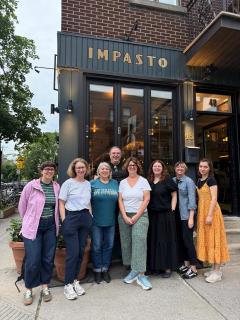
William & Mary group that attended the Digital Humanities Summer Institute.
How did you hear about this opportunity and what pushed you to apply?
I’ve been aware of DHSI for a long time, but never had the opportunity to go. When I came to visit William & Mary as part of my job visit, Rachel Hogan mentioned that the library had a standing relationship with DHSI. I decided to apply because I have an ongoing digital project that I needed to spend some time with.
What were your expectations going into the program?
I expected to learn a lot about digital mapping and learn new tools that might be useful for my project. That was absolutely the case.
What was your biggest takeaway?
DHSI is amazing! The community is so wonderful and welcoming. I was just so impressed by the range of topics available and the approach to learning at the center of the whole workshop, it felt so refreshing to be a student again.
What was your favorite part?
Having access to folks who know so much about the digital tools we were working with or know what might be helpful in the future was really wonderful. We were not only learning about new platforms, but they were on-hand to help troubleshoot certain aspects of my own project. The other folks in the class were also really helpful in working through certain platforms and thinking certain issues differently.
Were you able to explore Montreal?
I was! I stayed with another faculty member, and we often checked out a different part of the city after class each day. We found some really great restaurants. My partner also met up with me after the workshop for a few days and we checked out the Montreal Museum of Fine Arts and went to a Montreal Alouettes game (Canadian football).
Did you learn anything that was unexpected or challenged your perspective?
Well, I did, unfortunately, learn that certain aspects of my project are broken because of other hosting platforms, but that is kind of the nature of digital work. That said, it was helpful to have time to think about what might work going forward and what might need to shift.
How will this experience translate into your work and instruction at William & Mary?
As someone who uses digital maps in my work, includes them in my teaching, and has had students create them for assignments, I have a much better understanding of what platforms there are and how best to help them. The course that I took was also helpful in understanding best practices for teaching digital tools – it’s important to go slow and check in regularly with students.
Would you recommend this experience to other new faculty? If so, why?
Absolutely! If a new faculty member is interested in pursuing or working on a digital humanities project, DHSI is a great way to learn different skills or start thinking about the possibilities of digital platforms.