

Written by Neel Sawkar (Class of 2028) and Enna Carbone (Class of 2029)
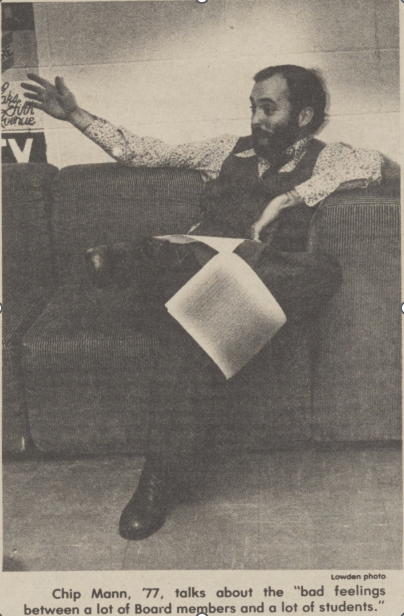
When John N. Dalton (W&M ‘53) ran for governor of Virginia in 1977, he pledged to appoint a recent graduate to the board of every state university. As governor, he made good on his promise by appointing Horace “Chip” Mann (W&M ‘77) to the Board of Visitors for the College of William & Mary, their shared alma mater. A 1978 Flat Hat interview revealed that Mann and Dalton had a long history, stemming from Mann’s time as a page in the Virginia House of Delegates while Dalton served in the legislature. Mann went on to work for Dalton’s gubernatorial campaign as his driver, logging over 6,000 miles together on the campaign trail, where the pair bonded over their affection for William & Mary (1).
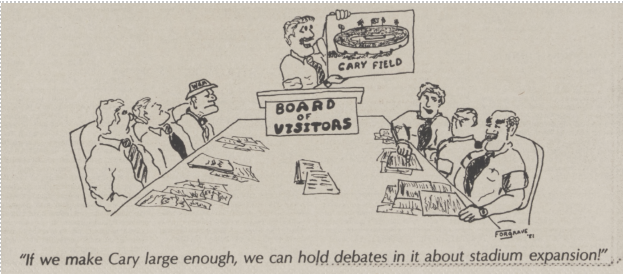
Having just graduated the previous spring, Mann was now one of seventeen members of the Board of Visitors tasked with leading the college. As the youngest person ever to serve, Mann brought a fresh perspective, for example, persuading the Board to continue building new dorms to preserve the close-knit campus community. He also helped organize the acquisition of VIMS (Virginia Institute of Marine Science) by the college. But one issue, in particular, came to dominate the Board’s attention during Mann’s tenure: the expansion of the football stadium at Cary Field. In fact, the stadium issue had been brewing for years, going back to his days as a student in the mid-1970s.
Although William & Mary had been a football powerhouse in the early and mid-20th century, things had taken a turn for the worse. Especially following the resignation of Coach Lou Holtz, who led a brief resurgence in the early 1970s, W&M football was languishing. In 1974, President Thomas A. Graves backed a resolution that would dramatically increase athletic fees charged alongside tuition. This infusion of cash was envisioned as a temporary four-year transition period back to athletic dominance, from which the team could then sustain itself financially. The newfound investment into the team yielded mixed results on the field, but financial problems persisted. Despite Graves’ intention to create a self-sustaining program, the football and basketball teams required the continuation of the 1974 resolution beyond the set end date of 1978 (2).
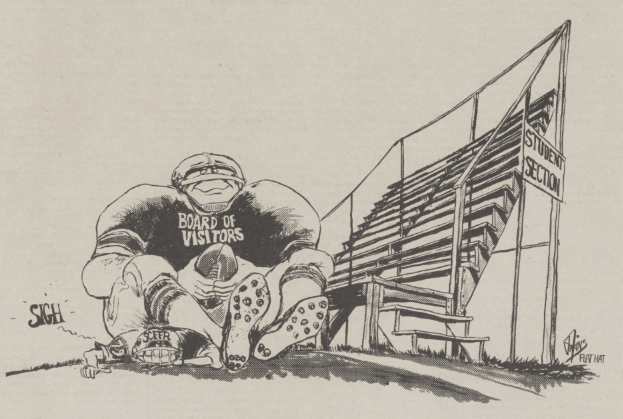
Students were generally skeptical of the college’s administration and their motives, part of a broader Vietnam War-era distrust of authority. Most students believed that money—their own money via athletic fees—was being spent on a failing dream of the past without their consent (3). Moreover, the campus was grappling with a new report that revealed that educators at William & Mary were highly underpaid. The average salary at the college was lower than the equivalent at the University of Virginia, Virginia Tech, Old Dominion University, and Virginia Commonwealth University. As a newly graduated alumnus, Mann understood campus opposition to spending more on athletics and represented those opinions to the Board of Visitors (4).
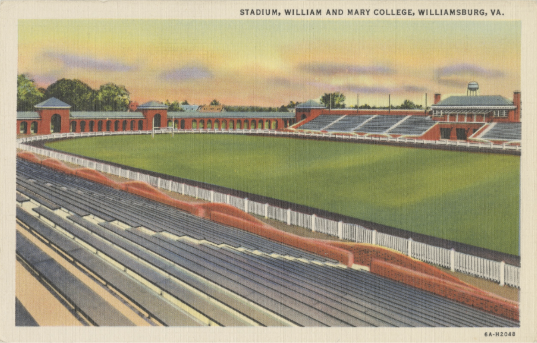
This put Mann in the minority on the Board, most of whom shared the opinion of older generations of alumni and donors, including his mentor Gov. Dalton, who fondly remembered the glory days of W&M football. The issue came to a head in 1978, as the Board laid plans for a dramatic expansion of the Cary Field stadium. They believed that a larger stadium would bring in better opponents and thus increase revenues. It was also intended as a proactive measure as the NCAA was deliberating on a new 30,000-seat stadium requirement for schools that hoped to compete in Division I-A. For context, the current Zable Stadium seats 12,500 people (5).
The Flat Hat reported that this expansion would cost $4.47 million. The Board defended the spending as a sound investment, but students feared that it signaled another increase in athletic fees, which, eventually, the administration confirmed was partially true. A combination of ticket revenue and student fees would be used to pay interest on a loan from the State of Virginia, though a substantial portion of the overall cost would be covered by an anonymous donor. The Flat Hat estimated a $10 increase in athletic fees, which had already increased from about $80 in 1973 to $210 in 1979. Giving voice to student opinion, Chip Mann told reporters that the Board of Visitors had to stop the cycle, as “we cannot continue to make student fees the scapegoat for the Athletics Department" (6).
The faculty were almost uniformly against the expansion project. A faculty vote with more than 200 participants revealed 92% opposition to the stadium expansion. Football coach Jim Root expressed dismay at “these academic types” who, in his view, could not appreciate the “very simple economics” that spending big on football was an investment in the college. “You don’t have to have a Ph.D. to figure that out,” he quipped, “or apparently, if you are a Ph.D., you cannot figure that out" (7).
Student sentiment also grew more heated. A Flat Hat poll of 262 students marked 95% in opposition, many of whom organized under the Student Committee for Fairness and Fiscal Responsibility (SCFFR), which held multiple protests against the Board’s stadium project. SCFFR disrupted the 1978 Charter Day convocation, unveiling a sign over Phi Beta Kappa Hall that read, “At What Price Division IA Football?” It was taken down, which SCFFR decried as censorship by the College. And during the proceedings, fourteen out of fifteen of the President’s Aides revealed protest buttons with the statement “What Price WM Football?" (8). The records of the Board of Visitors, held at Special Collections, contain a thick file of petitions, largely in opposition. Most of the complaints centered on financial concerns, though Williamsburg residents also worried that a 30,000-seat stadium would create traffic and parking chaos on game day. One student even wrote in to complain that an expanded stadium would block sunlight into their dorm window (9).
On February 25, 1978, SCFFR held a rally on the Sunken Garden while the Board was having a press briefing at Ewell Hall, announcing their intention to join the NCAA Division 1-A. President Graves, who was in fact quietly fighting with the Board against the stadium, spoke with the protestors and was met with boos and catcalls. Chip Mann explained that he hoped to bolster faculty salaries in line with peer institutions before funding the stadium expansion, but trying to convince the rest of the Board was “flogging a dead horse" (10).
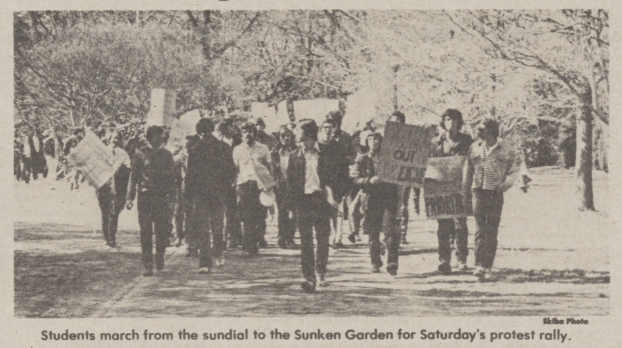
On February 1, 1979, the Board of Visitors held a decisive vote after President Graves urged them to reconsider the stadium expansion plan. In a contentious meeting, the Board rejected his request with a 13-4 vote. Mann was one of the four dissenting Board members who opposed the stadium expansion (11). Even the New York Times took note of the subsequent protest rally, estimating that 75% of students boycotted classes (12). Mann was committed to representing the student body on the Board of Visitors, fulfilling Gov. Dalton’s original vision to put a recent alumnus in power, but in this case, clashing with Dalton’s personal desire to see his beloved William & Mary football restored to national prominence. Dalton declined to renew Mann’s term on the Board of Visitors and instead selected Jerry Jebo, his former law partner. The Flat Hat lamented the decision, noting that “Mann was a breath of fresh air” in governing the university (13).
As Mann was on the outs, so was the expansion of Cary Field. In 1980, the Athletics Education Fund and the Board became wrapped up in a series of lawsuits brought by anti-expansion groups. Meanwhile, the vocal student protests caused the anonymous donor to withdraw from the project. And then the NCAA dropped W&M to Division I-AA, eliminating the requirement for such a large football stadium. Although students today are represented by a non-voting liaison to the Board of Visitors, Chip Mann and the experiment in intergenerational university governance has never been repeated. Nevertheless, the battle over Cary Field reminds us that student activism will always play an important role in guiding the college (14).
- The Flat Hat, December 1, 1978 (Special Collections Research Center, W&M Libraries). The personal papers of John N. Dalton are held at Special Collections, while his official papers from his time in office are maintained by the Library of Virginia.
- The Flat Hat, January 25, 1980; Godson, et al., The College of William & Mary: A History, Vol II (Williamsburg, VA: King and Queen Press, 1993), 856-57.
- The Flat Hat, January 25, 1980 (Special Collections Research Center, W&M Libraries).
- The Flat Hat, August 11, 1979 (Special Collections Research Center, W&M Libraries).
- “Walter J. Zable Stadium at Cary Field,” Tribe Athletics, https://tribeathletics.com/facilities/walter-j-zable-stadium-at-cary-field/1.
- The Flat Hat, March 2, 1978; Godson, et al., William & Mary: A History, Vol II, 858.
- The Flat Hat, August 11, 1979 (Special Collections Research Center, W&M Libraries).
- The Flat Hat, March 2, 1978 (Special Collections Research Center, W&M Libraries).
- “Board of Visitors Records” Series 1: Minutes and Agendas of Board of Visitors' Meetings, 1757-2020, UA 1, Box 40 (Special Collections Research Center, W&M Libraries).
- The Flat Hat, December 1, 1978; March 2, 1978; March 20, 1981 (Special Collections Research Center, W&M Libraries); Godson, et al. William & Mary: A History, Vol II, 857.
- ”Meeting Minutes February 1, 1979”, Board of Visitors Records Series 1: Minutes and Agendas of Board of Visitors' Meetings, 1757-2020, UA 1, Box 41 (Special Collections Research Center, W&M Libraries); W&M News, February 6, 1979 (Special Collections Research Center, W&M Libraries).
- The New York Times, February 11, 1979, “Students Protest Plan To Add Stadium Seats At William and Mary."
- The Flat Hat, March 20, 1981; March 27, 1981.
- Godson, et al. William & Mary: A History, Vol II, 856-59.